
Some days your brain works. Some days it doesn't.
Good Brain Day is a calm, practical place to understand life after a brain injury — for the people living with one, and for everyone around them.
How is your brain today?
No wrong answer. This only changes how much the page puts in front of you, and you can switch it any time.
Right now the page is showing everything.
Just the essentials
Three things, and nothing else
- Stop before you're tired, not after. Rest is the treatment.
- Write it down now. Later doesn't exist.
- Leave early if a place is too bright or too loud. Recovering from overload takes far longer than avoiding it.
Where would you like to start?
If you read nothing else
You are not lazy, difficult, or imagining it. An injured brain does ordinary things using far more energy than it used to.
Rest is not giving up — it is the actual treatment. Recovery is slow and uneven, and a bad week is not the end of progress.
Most of what makes life after brain injury harder than it needs to be is misunderstanding: yours, and everyone else's. This site tries to fix some of that.

Everything here is free
No account, no sign-up, no adverts. The tools run entirely on your own device and nothing you type is sent anywhere.
If you've got the energy for it
Read the whole picture
The section covers what happens to the brain, what recovery genuinely looks like, and who can help.
Show someone else
The section is written to be handed over. Plenty of people find that easier than explaining it themselves.
Start a habit
The and pay off most when used on the good days, not just the bad ones.
What this is. A free educational resource written in plain language. It is not medical advice and cannot replace assessment by a doctor, neurologist, neuropsychologist or rehabilitation team. If you are worried about symptoms, please talk to a health professional.
Warning signs
When to get help urgently
Most head injuries don't become emergencies. Some do — and the signs can appear hours or even a couple of days later.
Get emergency help straight away for any of these
- A headache that keeps getting worse
- Being sick repeatedly
- A seizure or fit
- Weakness or numbness in an arm or leg
- Slurred speech, or trouble speaking or understanding
- Vision changes, or pupils of different sizes
- Clear fluid or blood from the nose or ears
- Confusion that's getting worse, or not recognising people or places
- Becoming very drowsy, or hard to wake
- Any loss of consciousness, even briefly
If you're struggling to cope
Low mood, anxiety and hopelessness are common after a brain injury — partly from the injury, partly from everything it changes. This is a recognised part of brain injury, not a character flaw, and it responds to support.
Please tell your GP or rehabilitation team how you're feeling. If you need someone to talk to right now:
- UK & Ireland — Samaritans, free, 24 hours: 116 123
- US & Canada — Suicide & Crisis Lifeline: call or text 988
- Australia — Lifeline, 24 hours: 13 11 14
- New Zealand — Need to talk? free call or text 1737
Brain injury charities also run helplines staffed by people who understand this specifically — see Find support.
Emergency numbers
- UK — 999, or 111 for urgent advice
- US & Canada — 911
- Ireland — 112 or 999
- Australia — 000
- New Zealand — 111
Always get checked
Anyone on blood-thinning medication, or who has had a previous brain injury, should be assessed after a head injury even if they feel completely fine.
The basics
Understanding brain injury
For anyone — whether you have the injury, live with someone who does, or are simply trying to make sense of it.
What a traumatic brain injury is
A traumatic brain injury happens when an outside force damages the brain — a fall, a crash, an assault, a sporting collision, a blow to the head.
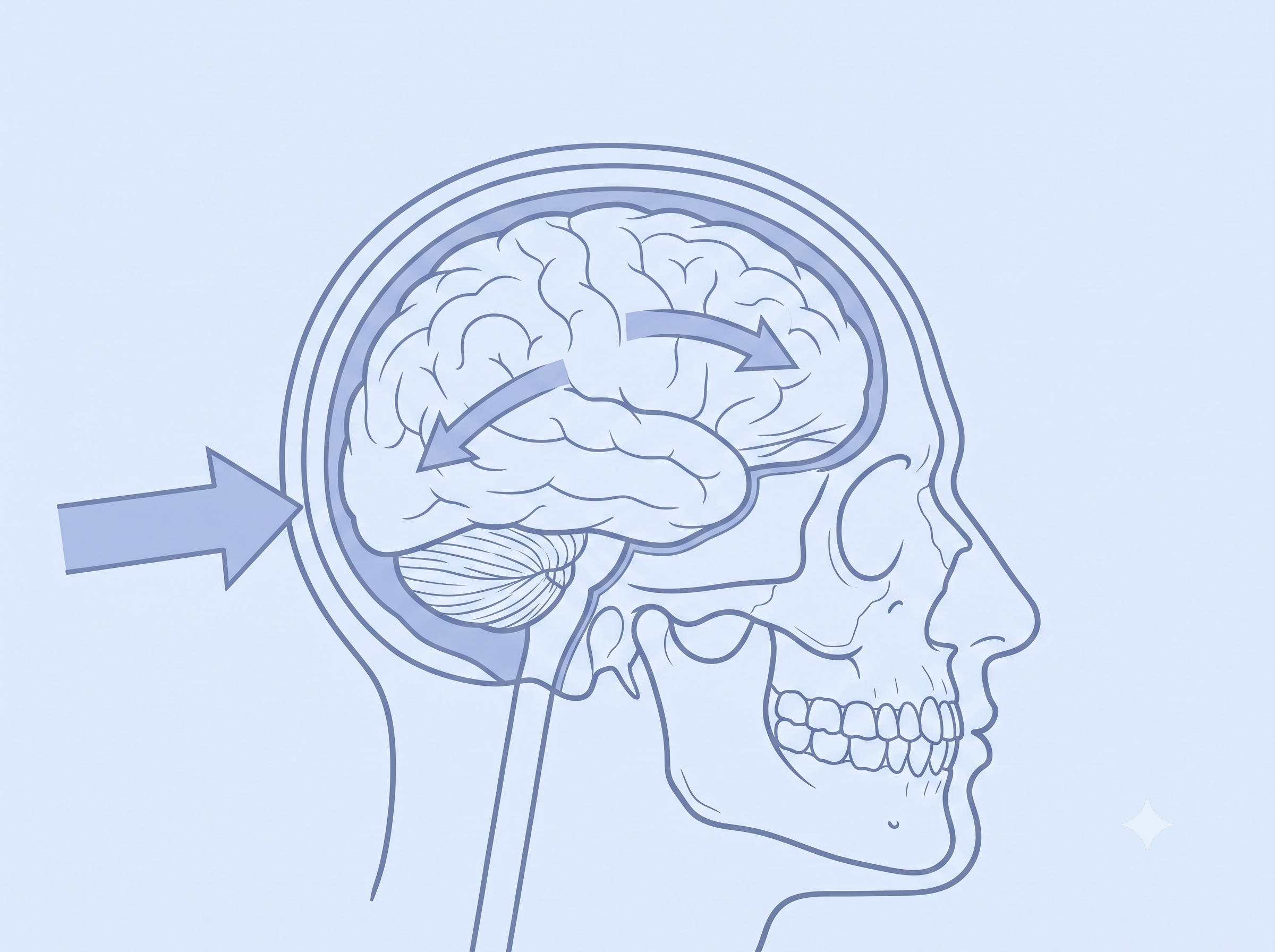
The brain is soft tissue floating in fluid inside a hard skull. When the head stops suddenly, the brain keeps moving, and it can be bruised, stretched or torn.
"Mild" is a medical classification, not a description of your life. A mild TBI can still change everything about your day.
Injuries are graded mild, moderate or severe based on things like how long consciousness and memory were disrupted — not on how much they affect you afterwards.
TBI or ABI?
Acquired brain injury is the wider term: brain damage from any cause during someone's life, including stroke, lack of oxygen, infection, tumour or haemorrhage.
Nearly everything on this site applies to both.
What actually happens
Two waves of damage matter. The first is the physical injury at the moment of impact.
The second unfolds over the following hours and weeks: swelling, inflammation, disrupted chemistry, and cells struggling to get the energy they need. Much of hospital care is about limiting that second wave.
Afterwards the brain begins reorganising, rebuilding connections and recruiting healthy areas to do jobs the damaged ones used to.
That rebuilding is the engine of recovery — and it is metabolically expensive. It's a large part of why you are so tired.
The invisible injury
Bones set. Scars fade. Brain injury usually leaves nothing to see.
Someone can look completely well while being unable to follow a conversation in a café or stay upright past two in the afternoon.
If you're being doubted or called lazy, know that this happens to almost everyone with a brain injury.
What recovery really looks like
Not a smooth upward line. Jagged. Most people improve fastest in the first six to twelve months, but meaningful change continues for years.
Good days and bad days are normal
A bad day isn't relapse. Usually it's a bill arriving for something you did one to three days earlier.
Progress shows up in weeks
Comparing today to yesterday will always look flat. Compare today to three months ago.
Beware the good day
Doing too much when you feel fine is the classic trap. It's called boom and bust, and it costs more than it gains.
Rest is treatment
Real rest — no screens, no conversation, low light — is when repair happens.
Sleep matters enormously
Brain injury often wrecks it. Raise it with your doctor; it's treatable, and fixing it improves everything else.
Recovery isn't only healing
A great deal of progress comes from learning to work with a changed brain rather than waiting for the old one.
How injuries get graded
You may see your injury described with a number or a category. It's worth knowing roughly what these mean, because they get used in reports, insurance claims and benefits applications.
Glasgow Coma Scale is a score from 3 to 15 recorded at the time, based on eye opening, speech and movement. Lower means more severely affected at that moment.
Post-traumatic amnesia is the period after the injury during which you couldn't form continuous new memories. Its length is often a better guide to long-term outcome than the initial score.
Neither number predicts your day-to-day life very well. People with identical scores end up in very different places.
Ask for your records
If nobody has explained what happened to you, you're entitled to request your medical records and to ask someone to go through them with you.
Many people find that finally understanding their own injury changes how they think about the recovery.
Grief is part of this
People expect the hard part to be the symptoms. Often the harder part is the loss — of a job, a hobby, independence, a sense of who you were.
That grief is real, and it deserves to be treated as grief rather than as being negative or failing to adjust.
Identity after brain injury tends to rebuild rather than restore. Many people describe eventually arriving somewhere different but genuinely liveable. That isn't a consolation prize, and it doesn't mean the loss didn't matter.
Who can help
Depending on where you live you may have access to some or all of these. It's reasonable to ask your GP for referrals.
Neurologist or rehab consultant
Medical management of the injury itself.
Neuropsychologist
Assesses memory, attention and thinking. Also helps with mood and adjustment.
Occupational therapist
The most practical help available — fatigue management, routines, strategies, return to work.
Speech & language therapist
Word-finding, conversation, and understanding what's said to you.
Physiotherapist
Balance, dizziness, movement, and building activity back up safely.
Brain injury case worker
Often through a charity, and often the person who actually gets things moving.
Take notes to appointments, and take another person if you can. Working memory is usually affected, and appointments are exactly the high-pressure situation where it fails. The will help you build a list beforehand.
Plain language
Symptoms & what helps
Open whichever ones match your experience. Each one covers how it feels from the inside, what helps, and what other people can do.
Nobody has all of these. Most people have a handful, and which ones dominate changes over time.
Very common Fatigue that sleep doesn't fix
What it feels like
Not ordinary tiredness. It arrives suddenly and completely, like a fuse blowing. Thinking becomes wading through mud, words stop arriving, and every other symptom gets louder at once.
It also arrives late — doing a lot on Monday can flatten you on Wednesday, which makes the cause very hard to spot.
What helps
- Pace, don't push. Plan the day against a fixed energy budget — the is built for this.
- Rest before you need it, not after you crash.
- Make rest real. Scrolling isn't rest. A dim quiet room with your eyes shut is.
- Chunk big activities with breaks between, even when you feel fine.
- Guard your best hours for the demanding things.
- Write down what you did and how you felt for a fortnight. Because fatigue lands one to three days late, the pattern is almost impossible to spot from memory.
What others can do
- Believe it, even when they look completely fine.
- Build breaks into plans by default.
- Make leaving early an agreed plan, not a failure.
- Take on the small logistics — driving, booking, remembering details.
Very common Memory problems
What it feels like
Usually it isn't old memories that go — it's forming new ones. Names evaporate. You walk into a room with no idea why. Something is agreed and genuinely gone an hour later.
That last one is particularly hard, because it can look like you weren't listening or don't care.
What helps
- One place for notes. A notebook, or one app on your phone. Not four places.
- Write it down in the moment. Later doesn't exist.
- Same place, every time for keys, glasses, wallet, phone.
- Alarms for everything, including what you're sure you'll remember.
- Build routines. Done the same way daily, they eventually run themselves.
- Photograph things — where you parked, the meter, the shelf.
What others can do
- Never say "I already told you." Just tell them again.
- Follow important conversations up with a text.
- Offer a cue, not a test — "we talked about Tuesday" beats "do you remember?"
Very common Concentration & attention
What it feels like
Holding a thought becomes work. A background conversation or someone walking past knocks you clean off a task. Following a film or a group conversation gets hard, because by the time you've processed one part the next has gone.
What helps
- One thing at a time. Multitasking now costs more than working in sequence.
- Cut the background — TV off, door shut, headphones on.
- Short blocks with real breaks — the handles this.
- Clear the space in front of you before starting.
- Ask people to speak one at a time. It's a reasonable request.
- Use subtitles. Two channels of input make one easier.
What others can do
- Get their attention before you start speaking.
- Pause when interrupted rather than talking over the top.
- Choose quiet places — corner tables, off-peak, home rather than a busy pub.
- Don't take a lost thread personally.
Sensory overload — light, noise, crowds
What it feels like
The filter that kept the world in the background is gone. Supermarket lighting is physically painful. Several conversations become one unbearable wall of noise. Screens and busy patterns can trigger nausea.
It builds — and once it tips over, thinking, speaking and emotional control all go at once. Many people say it's the symptom that most quietly shrinks their world.
What helps
- Leave before the tipping point. Recovering from overload takes far longer than avoiding it.
- Carry your kit — sunglasses, a cap, filtered earplugs or noise-cancelling headphones.
- Tame screens: lower brightness, warmer colour, bigger text. This page has a Warm colour setting in the top bar.
- Go at quiet times. Many supermarkets run a weekly quiet hour.
- Plan your exit in advance, so leaving isn't a decision made while overloaded.
- Have a reset routine — the walks through one.
What others can do
- Treat "I need to go" as information, not rejection — and go without discussion.
- Pick the quiet table. Turn the music down without being asked.
- Understand they may need hours of silence afterwards. That silence isn't sulking.
Emotional changes, irritability & low mood
What it feels like
Feelings arrive faster and larger, and the brake between feeling and reacting is weaker. Small frustrations produce disproportionate anger, and you can watch it happening without stopping it.
Some people cry or laugh at things that don't warrant it — that particular symptom is neurological rather than emotional. Low mood and anxiety are extremely common.
What helps
- Notice the fuel. Irritability is usually fatigue, overload, pain or hunger in disguise.
- Agree a pause signal meaning "I need ten minutes" — used with no argument and no follow-up questions.
- Leave the room. Removing yourself early is a skill, not a failure.
- Slow breathing genuinely works — the will time it.
- Ask about a neuropsychologist. Therapy adapted for brain injury is considerably more useful here.
- Tell your doctor about low mood. Treating it improves fatigue and thinking too.
What others can do
- Don't argue during an episode — nothing lands. Go quiet, lower the stimulation, wait.
- Come back to it later, calmly, if it needs discussing.
- Separate the person from the symptom out loud. "That was the injury talking" repairs a lot.
- Get your own support. Living with this is genuinely hard.
Headaches & pain
What it feels like
One of the most common lasting effects. It may be pressure, band-like tightness, migraine with light and sound sensitivity, or pain referred from the neck — whiplash and head injury very often happen together.
What helps
- Get them properly assessed. Different headache types need different treatment, and post-traumatic headache is often under-treated.
- Watch painkiller frequency. Taking them on more days than not can cause medication-overuse headache, which feels like the original problem worsening. Ask a pharmacist or GP.
- Ask about your neck. Neck-driven headaches respond very well to physiotherapy.
- Manage screens — brightness down, text bigger, regular breaks.
- Keep a simple diary of headache, sleep and what you'd done beforehand. A pattern on paper is far more useful to a doctor than "it's been bad lately".
Quiet basics that help
- Regular meals and steady hydration.
- Consistent sleep and wake times.
- Looking at something distant every so often when on screens.
Sleep problems
What it feels like
Brain injury commonly disrupts the systems controlling sleep. People sleep enormous amounts and wake unrefreshed, or can't fall asleep despite total exhaustion, or wake repeatedly. Days and nights can drift out of alignment entirely.
What helps
- Fix your wake time first, even after a poor night. It anchors everything else.
- Get daylight early — ten to twenty minutes outdoors does more for the body clock than most things.
- Keep naps early and short. Resting without sleeping still helps.
- Same wind-down every night: dim light, no screens for an hour, cool dark room.
Worth pushing for
- Sleep problems after brain injury are treatable, and often overlooked.
- Improving sleep improves fatigue, mood, memory and pain together — it's the highest-value thing to fix.
Word-finding & communication
What it feels like
The word is right there and won't come. You substitute the wrong one, or lose the thread mid-sentence. Following a fast group conversation is like trying to catch something already past.
It's exhausting and quietly humiliating — and worst exactly when you're tired or under pressure.
What helps
- Pause openly. "Give me a second, it's coming" beats rushing and losing it.
- Describe around it. "The thing you boil water in" keeps things moving.
- Ask for a moment before replying. Silence is allowed.
- Prepare for known conversations — note the two or three points beforehand.
- Ask about a speech and language therapist. This is precisely their expertise.
What others can do
- Don't finish their sentences unless asked.
- Leave gaps. Slow down. Let a pause sit.
- One question at a time, and give the answer time to arrive.
Planning, starting & finishing things
What it feels like
Often called executive function. You know what needs doing and cannot make the start happen. Tasks with several steps become impossible to sequence. You begin three things and finish none.
From outside this looks like procrastination. From inside it feels like a jammed switch.
What helps
- Break it down until the steps feel silly. Not "sort the paperwork" but "put the pile on the table" — the is for this.
- Only look at the next step, never the whole list.
- Set a start time, not a deadline. Starting is the broken part.
- Commit to five minutes only. Starting is usually the whole battle.
- Write checklists for anything repeated, then follow the checklist instead of your judgement.
- Body-double. Someone quietly present, even on a video call, makes starting far easier.
What others can do
- Help break the task down rather than taking it over.
- Offer one prompt, not a list of instructions.
- Read "I can't start" as literal, not as an excuse.
Dizziness & balance
What it feels like
Rooms tilt when you turn your head. Standing brings a swimming sensation. Busy visual environments — supermarket aisles, patterned carpets, traffic, scrolling screens — trigger nausea and unsteadiness.
What helps
- Get it assessed. Much post-injury dizziness is treatable, and vestibular physiotherapy is often very effective.
- Ask about your vision too. Eye-tracking and focusing problems are common after head injury and frequently missed.
- Move deliberately — turn your whole body rather than just your head, and rise in stages.
- Fix a point on the horizon when things swim.
Around the house
- Clear floors and good lighting.
- Non-slip mats, and something to hold near stairs.
- Don't rearrange furniture without saying.
Vision & visual processing
What it feels like
Text swims or doubles. Your eyes tire within minutes of reading. You lose your place on the line, or find you've read the same paragraph three times without taking it in.
Standard eye tests often come back normal, because the problem is usually in how the eyes work together and how the brain processes what they send — not in the sharpness of your sight.
What helps
- Ask about a behavioural or neuro-optometrist. They assess eye teaming, tracking and focusing, which routine sight tests don't cover.
- Increase text size well beyond what looks normal. The top bar on this site does it in one tap.
- Use a ruler or your finger to hold your place on the line.
- Try the for anything long — it shows a few words at a time with nothing around them.
- Reduce glare — matte screens, indirect lighting, and warmer screen colours.
What others can do
- Send things in large, plain text rather than dense PDFs or scans.
- Read forms and letters aloud rather than handing them over.
- Don't assume reading difficulty means they haven't understood.
Changed personality, motivation & impulse control
What it feels like
The hardest one to talk about. Injury to the frontal areas can change how someone acts — speaking without the usual filter, losing motivation entirely, becoming impulsive with money, or seeming flat about things they once loved.
Two things matter. Loss of drive is a symptom, not laziness — the brain's initiation system is damaged. And people often have limited insight into these changes, which is itself part of the injury rather than denial.
What helps
- External structure does the work internal motivation used to — routines, alarms, prompts, standing arrangements.
- Pre-commit on big decisions. Agree that anything over a set amount waits 48 hours and involves one other person.
- Neuropsychology helps a great deal here, for the person and the family together.
- Name the pattern, not the person. "The impulse thing is happening" is easier to hear and to act on.
What others can do
- Prompt gently and consistently rather than waiting for them to initiate.
- Set up practical safeguards early, agreed while things are calm.
- Get support for yourself. Personality change is a genuine loss, and grieving it doesn't make you disloyal.
For family, friends & carers
How to help — and how to last
You matter in this too. Brain injury reshapes the people around it, and the support you give works far better when you aren't running on empty.
Ten things that help most
Believe them
They look fine. They aren't. Taking symptoms at face value is the single most valuable thing you can offer.
Treat fatigue as real
It isn't tiredness and it isn't avoidance. Build rest into plans instead of waiting to be asked.
Lower the noise
Quiet table, TV off, one conversation at a time. Small changes buy them hours.
Put things in writing
Follow plans up with a text. It removes a whole category of conflict about who said what.
Give things time to land
Ask one question, then wait longer than feels natural. Processing takes longer now.
Keep them in charge
Help with the task, don't take it over. Autonomy is a large part of recovering a sense of self.
Notice wins out loud
Progress is slow enough to be invisible from inside. Naming it is genuinely useful.
Don't argue with a symptom
During irritability or overload nothing lands. Reduce stimulation, come back later.
Keep including them
Invite, and let them decline. Being quietly dropped is one of the loneliest parts.
Ask what would help
Then do that thing, rather than the thing you assumed would help.
Things to avoid saying
- "But you look so well." → try "How's your energy today?"
- "I already told you that." → just tell them again.
- "I forget things too." → it flattens something quite different into ordinary forgetfulness.
- "You just need to push through." → pushing through is what causes the crash.
- "When will you be back to normal?" → try "What's this week looking like?"
- "At least it wasn't worse." → try "That sounds really hard."

Practical ways to be useful
Offer specifics, not open offers
"I'm doing a shop Thursday, what do you need?" is far easier to accept than "let me know if you need anything."
Take on the admin
Phone calls, forms, benefits applications and booking are disproportionately draining. Doing those is enormous.
Come to appointments
Take notes. Ask the questions they'll forget to ask.
Protect their good hours
If mornings are their best window, don't fill it with errands.
Shorten visits by default
An hour of real company beats an afternoon that costs them two days.
Learn the exit signal
And honour it instantly, without discussion.
Looking after yourself
Carers of people with brain injury report high levels of strain, and the reasons are structural rather than personal.
The injury is invisible, so others don't understand it. Personality change can mean grieving someone who is still present. And the role usually arrives with no warning and no training.
Helplines listed under Find support are for you as well as for them. You don't need permission to call one.
What actually helps carers
- Talk to other carers in this situation specifically. You stop having to explain the basics.
- Ask for a carer's assessment if one exists where you live.
- Get your own support in place — counselling, your GP, respite. Not as a last resort.
- Keep something that is only yours. One activity, one friendship, one afternoon.
- Sustainable beats maximal. You'll be doing this for a long time.
- Resentment happens. It's a normal response to an abnormal situation.
The relationship changes too
Partners often describe sliding from being a partner into being a carer without ever agreeing to it. Roles get rewritten — who drives, who earns, who makes decisions, who manages the household.
That shift is worth naming out loud rather than letting it happen quietly, because unspoken role changes tend to breed resentment on both sides.
Intimacy is commonly affected as well, through fatigue, medication, changed confidence, or simply never being alone together any more. It's an awkward thing to raise with a clinician, and it's a completely legitimate thing to raise.
Wanting your relationship back is not the same as wanting them to be different. Both can be true.
Worth doing early
- Agree who handles what, explicitly, and revisit it as things change.
- Keep some time together that isn't about appointments or symptoms.
- Ask whether couples or family sessions are available through the rehabilitation team.
If you're supporting a child
Childhood brain injury behaves differently. Effects can appear years later, as the child reaches the age when the damaged skills would normally develop.
So a good recovery at eight can become obvious difficulty at thirteen. This is often missed and misread as behaviour or attitude.
Make sure the school knows, in writing, and push for formal educational support rather than informal goodwill.
Specialist help exists
Charities dedicated to childhood brain injury are listed in , and are worth contacting early rather than once problems appear.
Free · private · no account
Tools
Six practical tools for the things brain injury makes hard. Everything saves itself as you go — there are no save buttons and nothing to load.
It all runs in your browser, on your device. Nothing is uploaded and nobody else can see it.
Where your data lives. Everything stays in this browser on this device. It won't follow you to another device, and clearing your browser data will erase it. If you're in private browsing, saving may not work at all — the tools will still run, but only until you close the tab.
Calm & overload reset
Breathing out for longer than you breathe in calms the body's stress response. Follow the ring — you don't have to get it exactly right.
Press start whenever you like.
Grounding: 5–4–3–2–1
If your head is spinning, name — silently or aloud — five things you can see, four you can feel, three you can hear, two you can smell, and one you can taste.
Go slowly. Getting the number wrong doesn't matter.
Keep it short
Two or three minutes is plenty. If you feel light-headed, stop and breathe normally for a bit.
Overload reset
For when it's already tipped over. Work down the list — you don't need all of it.
Energy planner
Think of your energy as a fixed number of units each day. Add what you're planning, see what it costs, and spend the rest deliberately.
Add something to today
Tap a common activity, or add your own. Adjust the numbers to match your own experience after a week or two.
Today's plan
Using this well
- Plan to use about three quarters of your units. The last quarter is your buffer.
- Rest isn't free time — it's what refills the bank. Schedule it like an appointment.
- If you go over most days, the budget isn't wrong. The plan is.
- Fatigue often arrives one to three days late, so today's overspend may show up on Thursday.
Pacing timer
Work in short blocks and stop before you're tired, not after. Stopping while you still feel fine is the whole technique.
Ready — activity block
Blocks completed today: 0
What counts as a real break
Sitting or lying somewhere quiet and dim with your eyes closed. Slow breathing. Stepping outside. Doing genuinely nothing.
Not a break: phones, social media, email, television, or conversation. Those are more work for the same tired systems.
Focus reader
Long text is hard when your eyes skip lines or your attention slides. Paste anything in and read it a piece at a time.
—
You can also use the left and right arrow keys, or the space bar.
Task breaker
Big jobs jam the switch. Break one into steps small enough to feel almost silly, then only look at the next one.
What makes a good step
One action you could do right now without deciding anything.
"Find the policy number" — not "deal with insurance."
Appointment prep
Add things as they occur to you in the days beforehand, while you're thinking clearly. Then print the list and take it with you.
Worth asking every time
- What's the plan, and what happens next?
- Who do I contact if things get worse?
- Should I be referred to anyone else?
- Is there anything I should stop or start doing?
- Can you write the main points down for me?
Charities, helplines & communities
Find support
Real organisations run by people who understand brain injury. Most are free, and most will talk to family and carers as readily as to survivors.
You don't need to be in crisis to call a helpline. They're the right people to ring when you're confused about a diagnosis, stuck with a form, or simply want to talk to someone who gets it.
What to expect when you get in touch
Helplines
Usually staffed by nurses or trained advisors. They can explain a diagnosis plainly and help you work out what to ask for.
Local groups
Meeting others with brain injuries is the thing survivors most often say changed everything — you stop having to explain yourself first.
Carer groups
Separate, and specifically for you. Worth going to even if it feels self-indulgent. It isn't.
Advocacy & casework
Help with benefits, employers, schools and services. Often the difference between being entitled to something and receiving it.
Peer forums
Good company at three in the morning. Bear in mind they're other patients, not clinicians.

Not seeing your country?
Try the Everywhere else tab first — it lists international bodies and a directory that covers many more countries.
Failing that, search for "brain injury association" or "acquired brain injury" with your country or region.
Or ask the hospital team who discharged you — they usually know the local organisation, and a referral often moves faster than an application.
If you need help urgently — see . Charity helplines run limited hours; emergency services don't.