The basics
Understanding brain injury
For anyone, whether you have the injury, live with someone who does, or are simply trying to make sense of it.
What a traumatic brain injury is
A traumatic brain injury happens when an outside force damages the brain: a fall, a crash, an assault, a sporting collision, a blow to the head.
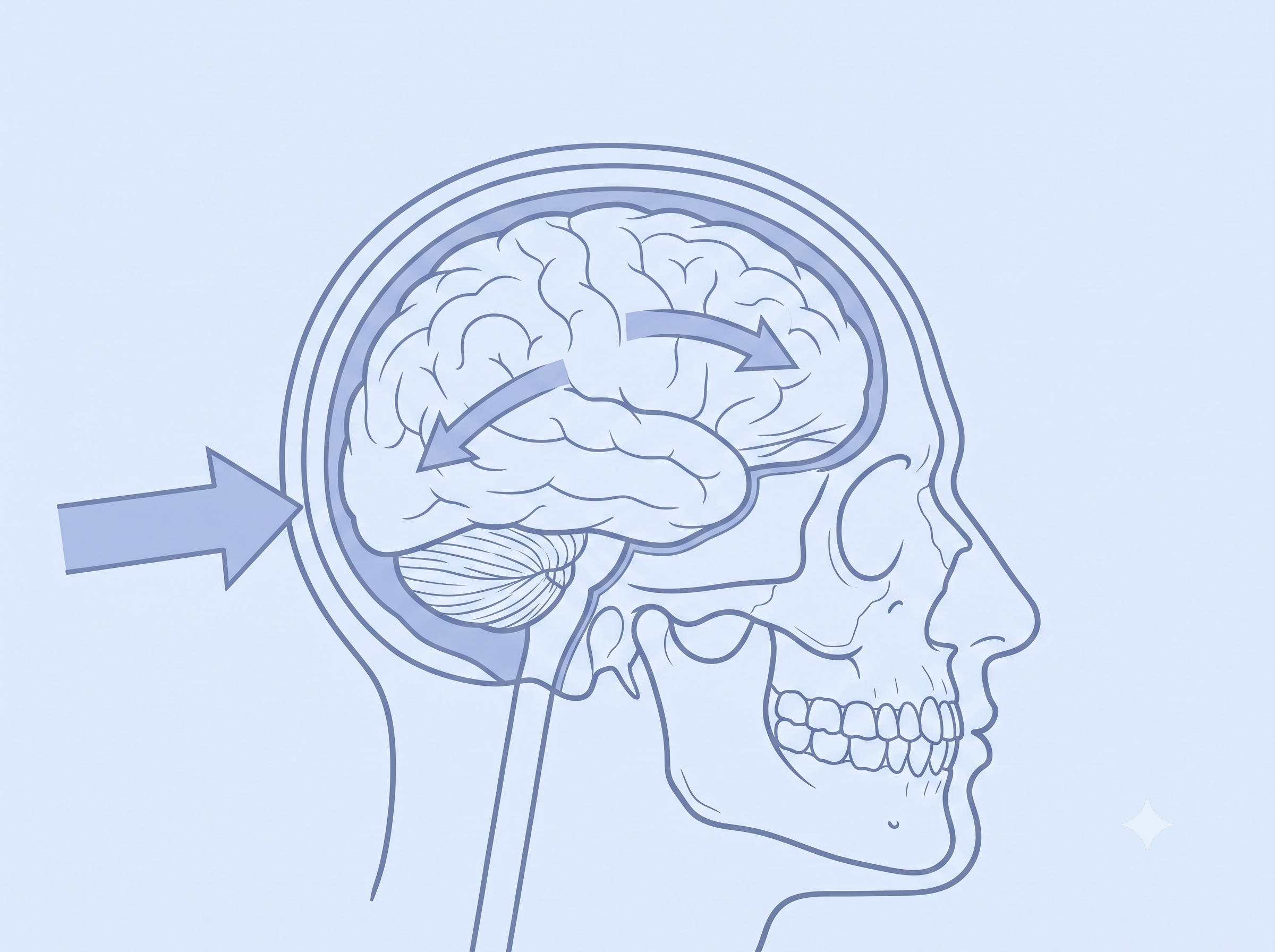
The brain is soft tissue floating in fluid inside a hard skull. When the head stops suddenly, the brain keeps moving, and it can be bruised, stretched or torn.
A blow to the head damages the brain: a fall, a crash, a collision.
The brain is soft, and floats inside a hard skull. When the head stops suddenly, the brain keeps moving.
"Mild" is a medical classification, not a description of your life. A mild TBI can still change everything about your day.
Injuries are graded mild, moderate or severe based on things like how long consciousness and memory were disrupted, not on how much they affect you afterwards.
TBI or ABI?
Acquired brain injury is the wider term: brain damage from any cause during someone's life, including stroke, lack of oxygen, infection, tumour or haemorrhage.
Nearly everything on this site applies to both.
What actually happens
Two waves of damage matter. The first is the physical injury at the moment of impact.
The second unfolds over the following hours and weeks: swelling, inflammation, disrupted chemistry, and cells struggling to get the energy they need. Much of hospital care is about limiting that second wave.
Afterwards the brain begins reorganising, rebuilding connections and recruiting healthy areas to do jobs the damaged ones used to.
There are two waves of damage. The impact itself, then swelling and disrupted chemistry over the following weeks.
Afterwards the brain rebuilds, using healthy areas to do the damaged areas' jobs.
That rebuilding is the engine of recovery, and it is metabolically expensive. It's a large part of why you are so tired.
The invisible injury
Bones set. Scars fade. Brain injury usually leaves nothing to see.
Someone can look completely well while being unable to follow a conversation in a café or stay upright past two in the afternoon.
If you're being doubted or called lazy, know that this happens to almost everyone with a brain injury.
What recovery really looks like
It's not a smooth upward line. The most significant recovery will be in the first 6 to 12 months, but improvements can still continue beyond that.
Even during times of noticeable improvement, you will have good days and bad days. Don't feel disheartened if you feel you've taken a step back, a good brain day will be along again soon.
It's not a smooth line. You will have good days and bad days. A step back isn't the end of progress.
Good days and bad days are normal
A bad day isn't a relapse. Your energy and performance will fluctuate, but a bad day doesn't mean things won't be better the next day.
Progress shows up in weeks
Comparing today to yesterday will always look flat. Compare today to three months ago.
Beware the good day
Doing too much when you feel fine is the classic trap. It's called boom and bust, and it costs more than it gains.
Rest is treatment
Rest is always a vital component of life, but even more so when managing a brain injury.
Sleep matters enormously
Brain injuries often cause havoc with sleep. If you're struggling getting to sleep, staying asleep, or getting restful sleep, it's worth speaking to your doctor.
Recovery isn't only healing
A great deal of progress comes from learning to work with a changed brain rather than waiting for the old one.
How injuries get graded
You may see your injury described with a number or a category. It's worth knowing roughly what these mean, because they get used in reports, insurance claims and benefits applications.
Glasgow Coma Scale is a score from 3 to 15 recorded at the time, based on eye opening, speech and movement. Lower means more severely affected at that moment.
Post-traumatic amnesia is the period after the injury during which you couldn't form continuous new memories. Its length is often a better guide to long-term outcome than the initial score.
Neither number predicts your day-to-day life very well. People with identical scores end up in very different places.
Reading a Glasgow Coma Scale score in your notes
What the score is made of
The score isn't one measurement. It's three separate checks added together, each testing a different thing, taken at a particular moment.
- Eye opening (E): scored 1 to 4. Do the eyes open on their own, only when spoken to, only in response to pressure, or not at all?
- Verbal response (V): scored 1 to 5. Can the person answer questions correctly, are they confused, using single words, making sounds, or silent?
- Motor response (M): scored 1 to 6. Can they follow an instruction like "squeeze my hand", move purposefully towards something uncomfortable, or not move at all?
Add the three together and the lowest possible total is 3, not zero, because each part scores at least 1. The highest is 15.
How it's written down
You'll often see it split into its parts rather than as a single number:
GCS 15 = E4 V5 M6: fully alert, oriented, following instructions.
GCS 3 = E1 V1 M1: no response in any of the three.
A time is usually written alongside it, because the score is only a snapshot of that moment.
If someone was on a ventilator, the verbal part can't be tested. You may see a T after it, or NT for "not testable", rather than a 1, a 1 would wrongly suggest they were silent when they simply couldn't speak.
Reading it sensibly
- The three parts matter more than the total. E2 V4 M3 and E4 V1 M4 both add up to 9, but describe very different situations.
- Look for the trend, not one number. Scores are usually recorded repeatedly. Whether it rose or fell over hours tells you far more than any single reading.
- Other things can lower a score that have nothing to do with the injury itself: sedation, alcohol, a very low blood sugar, or swelling that stops the eyes opening.
- The earliest score is often the worst one. A number recorded at the roadside or on arrival isn't a verdict on the outcome.
The bands you'll see quoted
Scores are commonly grouped as 13–15 mild, 9–12 moderate and 8 or below severe. These describe how affected consciousness was at that moment, not how severe the effects will turn out to be for you.
A low score early on does not close the door on recovery, and a high one doesn't guarantee an easy time of it. Plenty of people with a very low initial score go on to make substantial recoveries. If your notes contain a number nobody has explained, it is completely reasonable to ask your team to talk you through it.
Ask for your records
If nobody has explained what happened to you, you're entitled to request your medical records and to ask someone to go through them with you.
Many people find that finally understanding their own injury changes how they think about the recovery.
Grief is part of this
People expect the hard part to be the symptoms. Often the harder part is the loss of a job, a hobby, independence, a sense of who you were.
That grief is real, and it deserves to be treated as grief rather than as being negative or failing to adjust.
The hardest part is often the loss, not the symptoms. A job, a hobby, a sense of who you were.
That grief is real. It is not being negative.
Identity after brain injury tends to rebuild rather than restore. Recovery from brain injury can be described as finding and accepting the new you, rather than seeking to re-discover who you once were. That isn't a consolation prize, and it doesn't mean the loss didn't matter.
Who can help
Depending on where you live you may have access to some or all of these. It's reasonable to ask your GP for referrals.
Ask your GP about any of these.
Neurologist or rehab consultant
Medical management of the injury itself.
Neuropsychologist
Assesses memory, attention and thinking. Also helps with mood and adjustment.
Occupational therapist
The most practical help available: fatigue management, routines, strategies, return to work.
Speech & language therapist
Word-finding, conversation, and understanding what's said to you.
Physiotherapist
Balance, dizziness, movement, and building activity back up safely.
Brain injury case worker
Often through a charity, and often the person who actually gets things moving.
Take notes to appointments, and take another person if you can. Working memory is usually affected, and appointments are exactly the high-pressure situation where it fails. The appointment prep tool will help you build a list beforehand.
Is something missing from this page?
This site is built from what actually helps people. If you know something that should be here, please say so. It takes a moment and every suggestion gets read.